6 min read
·
The typing pool never died. It got promoted
The typing pool was cut, the admins were cut, and the typing moved up to people on four times the money. AI puts a typing pool back under every single person.
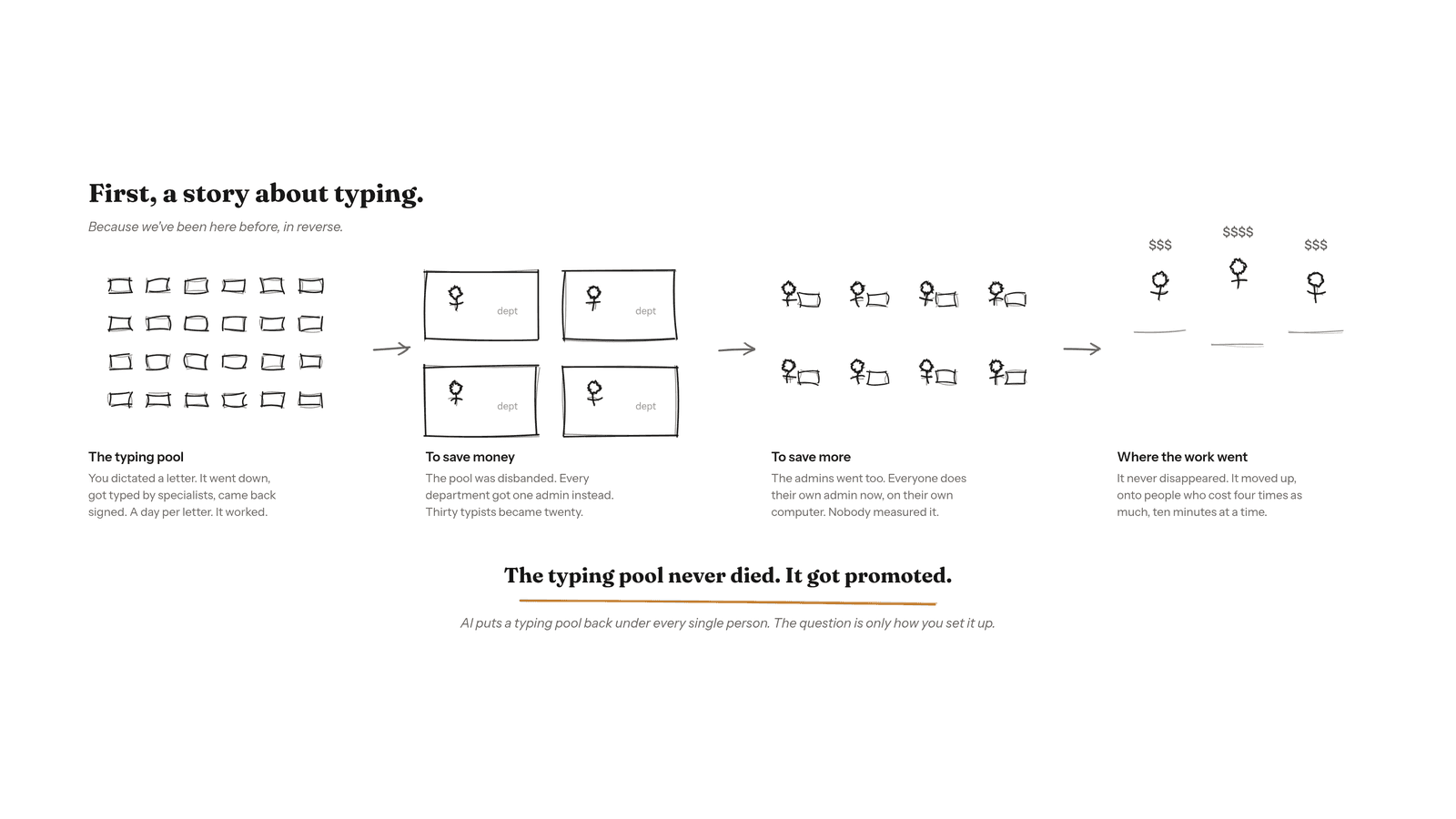
Highly paid staff do admin because the businesses that cut the typing pool never cut the typing. Offices once ran a pool: you dictated, it went down, it came back typed. It worked. To save money, the pool went, replaced by one admin per department. To save more, the admins went, and everyone does their own admin now. The work never disappeared. It moved up, to people on four times the money. That is why a senior engineer formats her own reports and a director spends Friday afternoon in Word. The typing pool never died. It got promoted. AI puts a typing pool back under every single person, and the question is only how you set it up. The setup matters because 88 percent of organisations already use AI and about 6 percent get business-wide value from it.
The pool went, the typing stayed
The admin work in a business has been climbing the pay scale for forty years. The typing pool was a room of people whose whole job was turning other people's thinking into finished documents. You dictated, it went down, it came back typed, and the person doing the thinking never touched the formatting. Then the pool looked like a cost, so it became one admin per department. Then the admins looked like a cost, so the work landed on everyone's own desk, one small screen each.
At every cut the salary attached to the typing went up. The document that a pool typist finished for a modest wage is now assembled, formatted, and proofed by the professional who wrote it, on four times the money. On paper each restructure saved a salary line. In practice each one converted cheap hours into expensive ones.
What the promotion costs
The promotion costs a business its most expensive hours on its least valuable work. Count what your senior people did last week that a pool typist once handled: assembling the monthly report, formatting the proposal, tidying the release, rewording a draft until it sounds like the company. None of it needs their judgement. All of it consumes their time, and their time is the priciest line in the budget.
The waste hides because it is spread thin. No single afternoon of formatting looks worth fixing, so it never gets fixed, and the same business that would question one unnecessary hire absorbs the equivalent in scattered senior hours without noticing.
AI puts a typing pool back under every single person
AI reverses the promotion. Each person hands their thinking over, the finished document comes back, and for the first time since the pool closed, the typing sits below the thinker again. The difference from the old pool is reach: this one sits under every single person, including the ones who never had support at any point in their career.
That is the plain commercial case for AI in an established business. The strategy conversations can come later. The first win is that the hours your best people spend producing documents come back to them.
The question is only how you set it up
The gap between the 88 percent who use AI and the roughly 6 percent who get business-wide value from it is setup. A typing pool worked because the whole building's documents came out of it to one standard. A model with no standard behind it types differently for every person and every prompt, so each person gets a private pool with its own habits, and the company's documents drift apart. Then someone senior rewords the output to sound like the company again, and the promotion is back.
What holds it together is a standard that lives in the environment: a foundation built for the model, applied the same way on every document, for every person. How that works across a whole team is covered in keeping team documents on brand with AI.
What setting it up properly looks like
Ortopylot builds the pool with the standard already in it. The Setup, $2,000 paid once, captures your brand, structures it into a foundation, installs it into your team's Claude environment, and shows the team how to work with it. The Implementation, from $10,000, adds working systems, reports that assemble themselves and releases that arrive ready to review, with the team trained on their own real documents until it is normal. You pay once and it is handed over. Clients who want Ortopylot to stay on and run it with them arrange that separately.
See how it works at ortopylot.com/how-it-works. Two minutes on what we would build, then tell us about your business and the documents your team makes.
Common Questions
Why do highly paid staff do so much admin?
Because the typing pool and then the department admins were cut, and the work they did moved up to the professionals themselves, people on four times the money. The typing never disappeared. It got promoted along with everyone else.
How do I reduce admin for knowledge workers?
Put the document production back below the thinker. AI does that when it is set up with a standard behind it: each person hands over the thinking and the finished, on-brand document comes back. The Setup that installs that standard is $2,000, paid once.
Can AI really do the work of a typing pool?
Yes, and further. A pool typed what it was given. A properly set up Claude assembles reports, drafts releases, and formats proposals in the company's brand, ready to review. The condition is the standard behind it, because an unstructured model types differently every time.
Why do most companies get so little value from AI?
88 percent of organisations already use AI, and about 6 percent get business-wide value from it. The gap is setup: most use is personal and unstructured, so every person's output drifts and someone senior still rewords it afterwards.
What does it cost to set this up?
The Setup is $2,000: the brand foundation built, installed into Claude, and the team shown how to use it. The Implementation starts at $10,000 and adds working systems plus training on your own real documents. Both are paid once, with no subscription.
Will staff actually use it?
They will if the training runs on their own live documents, which is how Ortopylot does it. A tool shown once in a demo gets ignored. A pool that hands back this week's proposal finished gets used, because it gives people their hours back.
Does this replace our admin staff?
For most established businesses there is little left to replace, since the cuts happened years ago and the admin already sits with senior people. The setup gives those people their typing pool back rather than removing anyone.
Read the post. Now see how the system works.
The two-minute version of how it all fits together. Form on the page if you want to talk.
See How It Works
© 2026 Ortopylot. Operating from Perth, Western Australia.