6 min read
·
Two ways to set up AI in a company
An AI team of specialists, or everyone gets the colleague. Same destination, different politics, and which model suits which company.
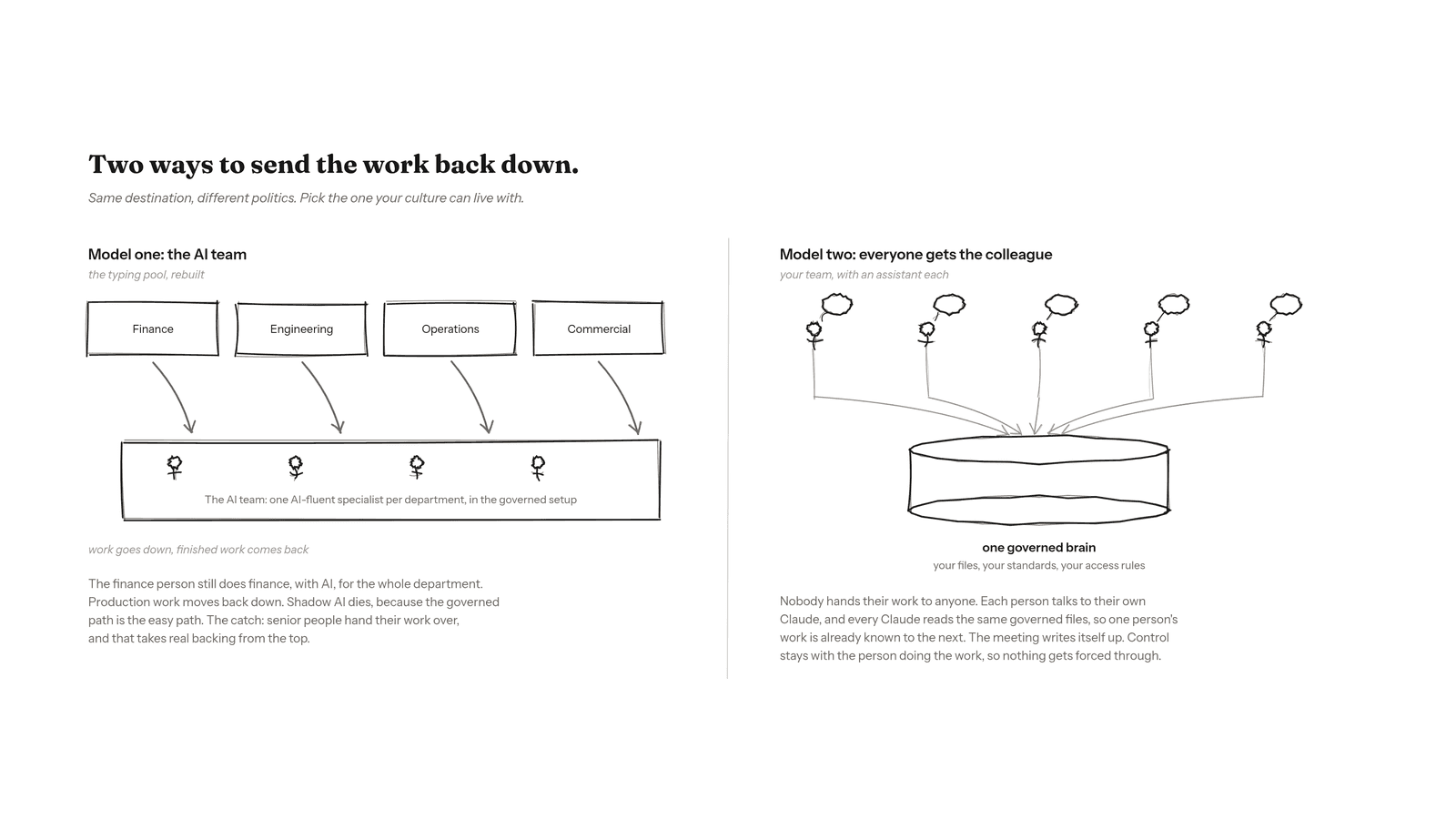
There are two workable ways to structure AI in a company. Model one is the AI team: one AI-fluent specialist per department, work goes down, finished work comes back. Model two is everyone gets the colleague: each person talks to their own Claude, and every Claude reads the same governed files. Both models end at the same place, a business whose documents and routine work run through AI to one standard. Same destination, different politics. Model one concentrates the skill in a few hands and keeps everyone else's day unchanged. Model two changes everyone's day a little and concentrates the standard in the environment instead of in people. Which one suits you depends on how your company already works, and the choice matters more than the tools, because it decides who holds the skill when someone resigns.
Model one is the AI team
Model one puts one AI-fluent specialist in each department and routes the work through them. A manager needs a proposal, it goes down to the specialist, and the finished work comes back. The rest of the team keeps working the way it always has. Nothing about their day changes.
The appeal is control. Quality sits with a handful of people who are good at this, the training cost covers four or five heads instead of forty, and nobody has to move anyone who does not want to move. The structure is also familiar, since it is how companies already run design, legal review, and anything else that needs a specialist. The cost is the queue. Every document waits its turn behind someone else's, and the specialists become the people the whole building depends on.
Model two is everyone gets the colleague
Model two gives each person their own Claude, and every Claude reads the same governed files. Nobody queues and nothing goes down or comes back, because the person who needs the document produces it, finished and on brand, in the moment they need it. The governed files are the part that makes this work: one shared foundation every Claude reads, so forty people producing their own documents still produce them to one standard.
The appeal is speed and reach. The work happens where the need is, and the skill of using it spreads across the whole team instead of pooling in a few heads. The cost is change: everyone's day shifts a little, and the setup has to be done properly, because forty ungoverned Claudes produce forty private styles.
Same destination, different politics
Both models arrive at a business whose routine documents come out finished, on brand, and to one standard. The difference is where the standard lives and who has to change. In model one the standard lives in people, the specialists, and the politics are about dependence: what happens when the department's AI person is sick, promoted, or hired away. In model two the standard lives in the environment, in the governed files, and the politics are about adoption: whether everyone actually takes the colleague they have been given. Neither set of politics is imaginary. One of them suits your company better than the other.
Which model suits which company
Model one suits companies with a strong departmental structure, work that already flows through specialists, and a culture where quality control belongs to named people. It also suits a cautious first year, since it can run as a pilot in one department. Model two suits companies where everyone writes, proposals, reports, client emails, posts, and where a queue in front of a specialist would cost more than the training. Below roughly 50 people, model two is usually the honest fit, because a business that size cannot spare a head per department and its senior people are already doing their own admin anyway.
Ortopylot sets up model two by default
Ortopylot sets up model two, because the standard lives in the environment rather than in any person. The foundation, a full set of foundational documents built in a specific structure, is installed into the company's Claude environment where every Claude reads it. Then the team is trained on their own real documents until the colleague is normal. The Setup is $2,000 and The Implementation starts at $10,000, both paid once. Nobody becomes the single point the building depends on, and a resignation takes nothing with it. Pulse Technology Hub runs this model today, and the Pulse case study shows what it looks like across a real team.
See how it works at ortopylot.com/how-it-works. Two minutes on what we would build, then tell us about your business and the documents your team makes.
Common Questions
Should a company have an AI team or give AI to everyone?
Both work. An AI team suits companies with strong departments and work that already flows through specialists. Everyone gets the colleague suits companies where everyone writes and a queue would cost more than the training. Below roughly 50 people, the everyone model is usually the better fit.
What is the risk of the AI team model?
Dependence. The standard lives in a few specialists, so a resignation, a promotion, or a sick week takes capacity with it, and every document queues behind someone else's. The model trades everyone else's comfort for that concentration.
How do you keep quality consistent when everyone uses AI?
With governed files: one shared foundation every person's Claude reads, so forty people producing their own documents still produce them to one standard. Without it, each person's Claude develops its own habits and the company's documents drift apart.
Which model costs less?
The AI team carries salaries, one specialist per department, every year. The everyone model carries a one-off setup: $2,000 for the foundation, from $10,000 for a full implementation with systems and training. After the setup there is no recurring cost.
Can we run both models at once?
Yes, and some companies should. A specialist can own the complex work, long tenders or campaign material, while everyone else uses their own Claude for daily documents. The governed files keep both to the same standard.
What are governed files?
A shared set of foundational documents, built in a specific structure for the model, that every Claude in the company reads. They carry the brand and the standard, so the output holds no matter who is typing.
How does Ortopylot set up the everyone model?
The brand is captured and structured into the foundation, installed into the company's Claude environment, and the team is trained on their own real documents until it is normal. Paid once, handed over, no subscription. Ongoing operations are by arrangement.
Read the post. Now see how the system works.
The two-minute version of how it all fits together. Form on the page if you want to talk.
See How It Works
© 2026 Ortopylot. Operating from Perth, Western Australia.