6 min read
·
The seven stops between asking AI a question and running your business with it
Seven stops between asking AI a question and running the business with it. Where most companies actually sit, and what moving a stop takes.
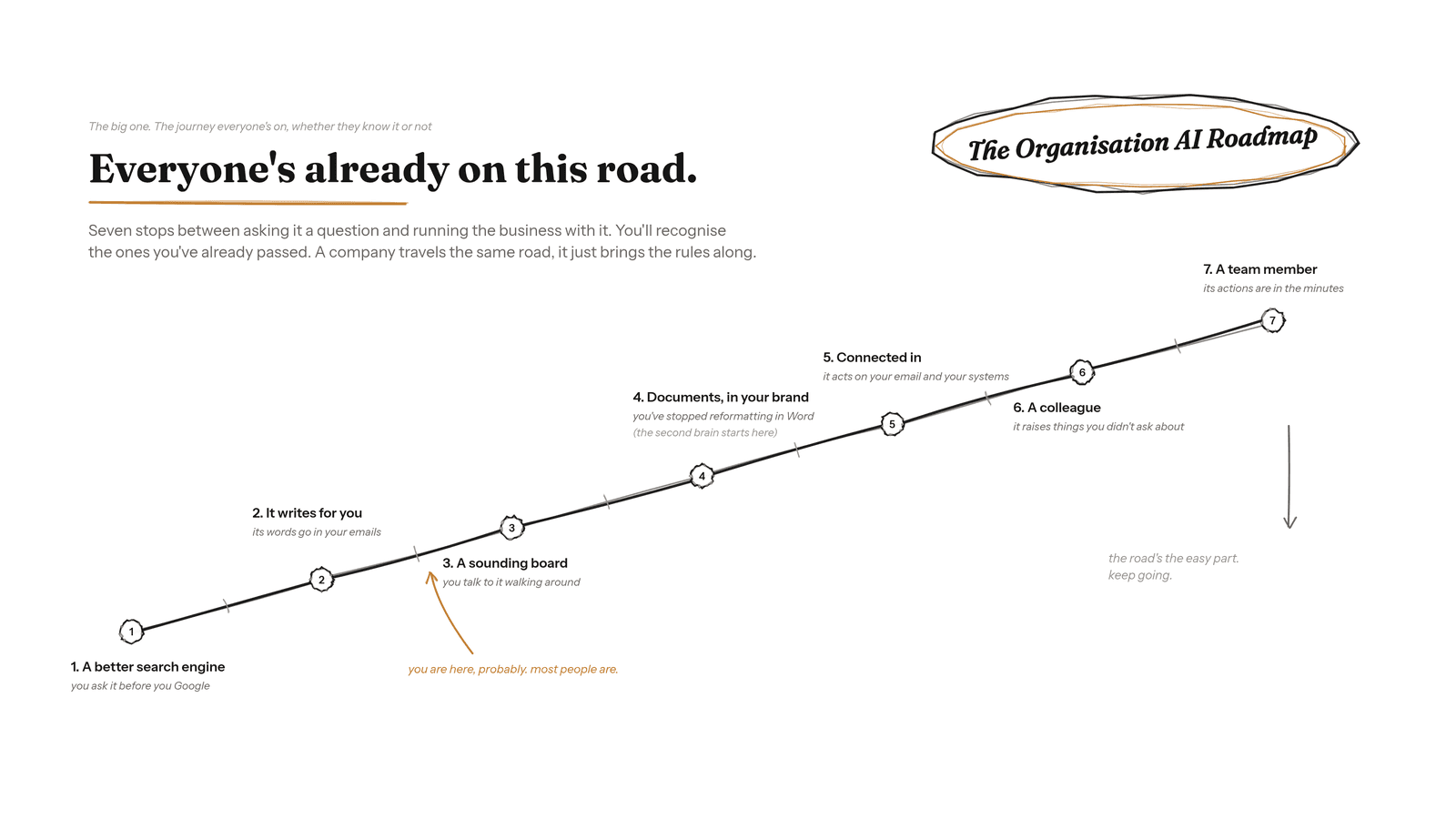
AI adoption in a business runs through seven recognisable stops, and knowing which one you are standing at tells you what to do next. One, a better search engine: you ask it before you Google. Two, it writes for you: its words go in your emails. Three, a sounding board: you talk to it walking around. Four, documents, in your brand: you've stopped reformatting in Word. Five, connected in: it acts on your email and your systems. Six, a colleague: it raises things you didn't ask about. Seven, a team member: its actions are in the minutes. Most businesses sit between stops two and three. The distance from there to stop four is smaller than it looks, and stop four is where AI stops being personal and starts belonging to the business.
Stops one to three are personal
The first three stops live in one person's browser and cost the business nothing to reach. At stop one the model is a better search engine, the place you ask before you Google. At stop two its words start going into your emails, which is the first time AI output leaves your screen and lands in front of someone else. At stop three it becomes a sounding board, the thing you talk to walking around, testing an idea before you say it out loud in a meeting.
Between stops two and three, draw a marker on the road: you are here, probably, most people are. Nothing at these stops needs permission, budget, or setup, which is exactly why nearly every business has people standing on them already.
Stop four is where the second brain starts
Stop four is documents, in your brand, and it is the first stop that belongs to the business rather than to a person. You've stopped reformatting in Word, because the documents come out finished. A proposal written by one person and a report written by another read as the same company, since the standard sits in the environment instead of in anyone's head.
The second brain starts here. From stop four onward the business is accumulating structured, governed material that everything later reads from, so this stop is less a feature and more the point where the later stops become possible. Reaching it takes deliberate work, which is why so few businesses are past it. How a whole team gets there is covered in keeping team documents on brand with AI.
Stops five to seven put AI inside the operation
The last three stops move the model from producing documents to carrying work. At stop five it is connected in: it acts on your email and your systems, so a request becomes an action rather than a draft. At stop six it behaves like a colleague: it raises things you didn't ask about, because it can see across the business and notice what a busy person misses. At stop seven it is a team member: its actions are in the minutes, meaning it holds responsibilities and is accountable in the record like anyone else at the table.
These stops sound distant from where most businesses stand. They are running today in small versions, and every one of them reads from the material that started accumulating at stop four.
What moving stops takes
Each stop takes something different, and the price of the next one is always visible from where you stand. Stops one to three take curiosity and nothing else. Stop four takes a structured foundation built for the model and a team trained to work with it, which is the first stop that takes real work. Stop five takes connections into your email and systems, plus rules about what the model may touch. Stops six and seven take trust, earned over months of watching stop five behave.
Nobody skips stops. A business that wires Claude into its systems before its documents hold a standard gets faster versions of inconsistent work. The order is the whole method.
Where Ortopylot gets you on the road
Ortopylot gets a business to stop four, and a full engagement carries it into stop five. The Setup, $2,000 paid once, builds the foundation, installs it into your Claude environment, and shows your team how to use it. That is stop four: documents, in your brand, no reformatting afterwards. The Implementation, from $10,000, adds the working systems, reports that assemble themselves and releases that arrive ready to review, with the team trained on their own real documents. That is the front edge of stop five.
The figures worth sitting with: 88 percent of organisations already use AI, and about 6 percent get business-wide value from it. The gap between those two numbers is the road above.
See how it works at ortopylot.com/how-it-works. Two minutes on what we would build, then tell us about your business and the documents your team makes.
Common Questions
What are the stages of AI adoption in a business?
Seven stops: a better search engine, it writes for you, a sounding board, documents in your brand, connected in, a colleague, and a team member. The first three are personal use. Stop four is the first that belongs to the business, and most companies sit between stops two and three.
How far can a business take AI?
To stop seven, where the model is a team member whose actions are in the minutes. Small versions of that run today. Getting there means passing through stop four first, because the later stops all read from the governed material that starts accumulating there.
Where are most businesses on AI adoption?
Between stops two and three: the model writes some emails and works as a sounding board. 88 percent of organisations already use AI, and about 6 percent get business-wide value from it, which shows how few have moved past personal use.
Why do AI documents need to be in our brand?
Because stop four is where the business, rather than individual people, starts owning the output. Documents in your brand mean a proposal by one person and a report by another read as the same company, and the structured material behind that is what every later stop builds on.
What does it take to move from using AI personally to using it as a business?
A structured foundation the model applies the same way every time, installed where the team works, with the team trained on their own documents. That is the jump from stop three to stop four, and it is the first move that takes deliberate work rather than curiosity.
Does a small business need to reach stop seven?
No. Most businesses get their return at stops four and five, where documents come out finished and routine reports assemble themselves. The later stops are available when the earlier ones have earned trust.
Where does Ortopylot get a business to?
Stop four with The Setup at $2,000, and into stop five with The Implementation from $10,000: the foundation, the working systems, and the team trained on their own real documents, handed over with no subscription.
Read the post. Now see how the system works.
The two-minute version of how it all fits together. Form on the page if you want to talk.
See How It Works
© 2026 Ortopylot. Operating from Perth, Western Australia.